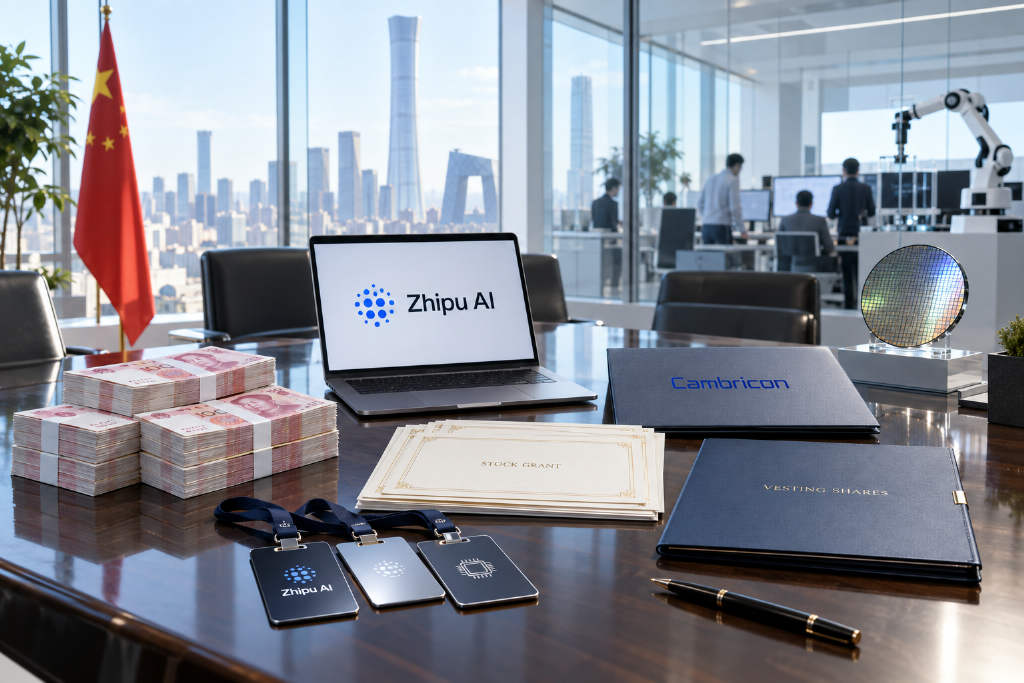
AI talent2026-09-21 09:46:10Pay for key talent is rising across China’s AI sector, with Zhipu’s executive average topping TencentChinese technology companies tied to the AI supply chain are paying sharply higher compensation to secure key talent, even before some businesses turn profitable. A compensation review covering 30 listed companies across large AI models and AI applications, AI chips and semiconductors, and robotics and embodied intelligence, plus three major internet firms as benchmarks, shows how salary design and equity incentives now reflect each company’s stage of development and hiring strategy. The figures cited in the report are striking. Zhipu posted 2025 revenue of 724 million yuan and a net loss attributable to shareholders of 4.698 billion yuan, yet Chairman Liu Debing received total annual compensation of 157 million yuan, including 156 million yuan in share-based payment. Cambricon’s 2026 restricted stock incentive plan proposes granting 5 million restricted shares to 945 employees, equal to an 85.37% coverage ratio based on its 1,107 employees at the end of 2025. The report also points to a wider AI labor boom. According to 36Kr, PhD interns in core teams at ByteDance, Tencent and Alibaba can earn 5,000-6,000 yuan a day. Maimai’s September AI talent mobility report said newly posted AI jobs rose 789.47% year over year in January-July 2026, with average monthly pay at 63,160 yuan. Across the three sectors, executive average monthly pay was highest in large-model and AI application companies, followed by chipmakers and then robotics firms.460
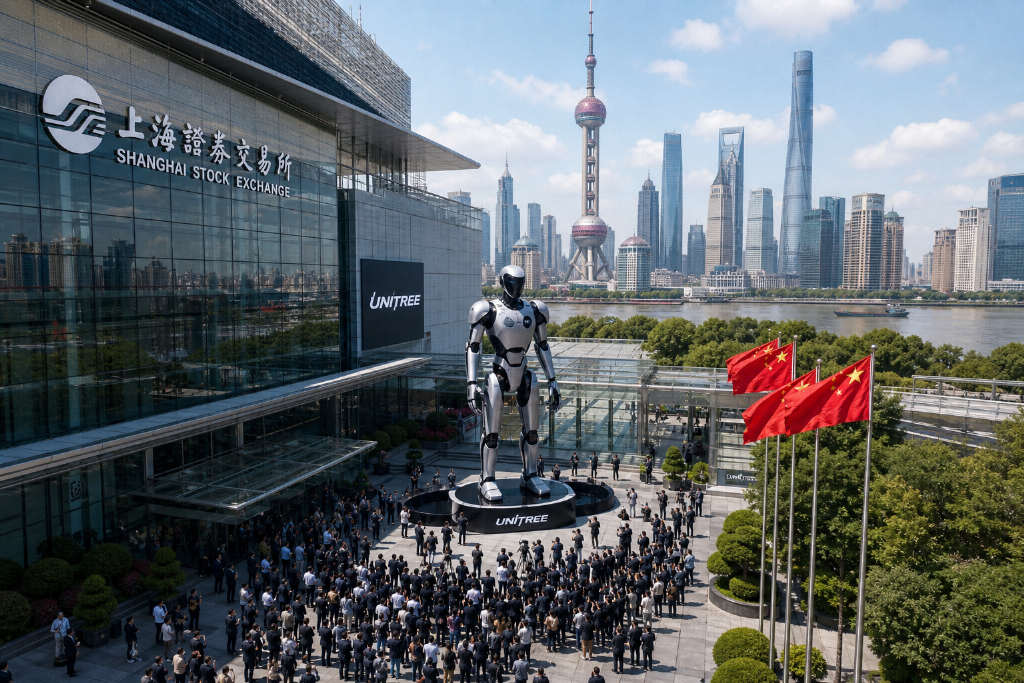
Unitree Techn2026-08-19 03:21:43Unitree Technology Debuts on STAR Market, Jumps Over 500% at the OpenUnitree Technology, described in the source report as the first listed humanoid robotics company, began trading on China’s STAR Market on Tuesday under the ticker 688836. After the opening bell, the stock rose more than 500%, pushing the company’s market capitalization above 350 billion yuan. Before the offering, the company had an equity incentive platform called Shanghai Yuyi, which held 39.8286 million shares, equal to a 10.9414% stake in Unitree. The report said three company executives held indirect stakes through that platform: Yang Zhiyu, head of mechanical structure, with 0.49%; Chen Li, head of sales and service systems, with 0.26%; and Zhang Yangguang, head of algorithms and software, with 0.15%. Based on a 350 billion yuan market value, the corresponding value of those holdings was calculated at about 1.715 billion yuan for Yang, 910 million yuan for Chen, and 525 million yuan for Zhang, according to the figures cited in the source material.1090
Unitree2026-08-07 04:53:00Unitree IPO draws scrutiny after prospectus shows only 14 employees received equity incentivesUnitree Technology is set to open subscriptions on Aug. 10 at an IPO price of 150.8 yuan per share, implying a valuation of 61 billion yuan. But one detail in its prospectus has become a focal point: only 14 employees had received equity incentives as of the signing date, despite the company employing 480 people. Of those, 11 had exercised their awards, while nine employees who were once granted incentives later left the company and had their awards canceled, putting the attrition rate among granted employees at 39%. The filing shows Unitree used a layered employee shareholding structure centered on Shanghai Yuyi, with incentive grants priced at 1 yuan per unit of registered capital. The arrangement includes a long lock-up period, four-stage vesting tied to performance, and repurchase clauses that allow the company to buy back interests at the original price in certain cases. The prospectus also shows share-based payment expenses of about 368 million yuan combined in 2022 and the first nine months of 2025. Compared with peers including UBTECH and Dobot, whose employee incentive programs cover far more staff, Unitree’s narrow participation rate has become a key issue for investors assessing its governance and retention structure ahead of listing.2140
CXMT2026-07-28 05:45:08Inside CXMT’s Hefei campus: rank-and-file staff remain outside the equity windfall as expansion reshapes the areaOn July 27, CXMT (688825.SH) surged more than fivefold at the open and closed at RMB 49 per share, lifting its market value to RMB 3.28 trillion and making it the most valuable company in China’s A-share market. But a field report from Time Weekly at the company’s Hefei headquarters suggests the stock euphoria has yet to reach most frontline employees. According to employees interviewed by the outlet, equity incentives come with clear rank requirements. Staff said eligibility starts at level 9, equivalent to section-chief rank, while many ordinary employees are concentrated at levels 11 and 12. One employee said online claims about “wealth creation” among CXMT workers do not reflect the situation for most newer hires. The report also describes tight information controls and elevated security around the campus. Employees said many staff in R&D and wafer workshops must surrender their phones during work, and multiple workers declined interviews, saying management had instructed them not to speak externally. At the same time, CXMT’s expansion is spilling beyond the factory gates. Construction on the company’s third-phase project is under way, suppliers have gathered nearby, and the Changgang area has seen stronger commercial activity and rising housing prices since 2021, according to local residents interviewed by the publication.2100
Weizhao Semic2026-07-17 12:03:08Weizhao Semiconductor files again for Hong Kong listing as profit swings to loss and CSRC questions deal pricingShenzhen Weizhao Semiconductor Co., Ltd., a power semiconductor device supplier and a national-level "little giant" enterprise, has filed a fresh application for a main-board listing in Hong Kong, with GF Securities serving as sole sponsor. The move comes after its first filing, submitted on Jan. 12, 2026, lapsed six months later. The renewed application arrives as the company’s operating picture weakens. According to its prospectus, Weizhao posted a net loss of 510,000 yuan in the first five months of 2026, compared with a profit of 26.529 million yuan a year earlier. Gross margin fell to 17.9% from 22.4%, while the revenue share of its higher-margin WLCSP products dropped from 46.3% to 27.4%. Regulatory scrutiny has also intensified. In June 2026, the China Securities Regulatory Commission asked the company six questions in supplemental filing materials for overseas listing registration, focusing on whether recent share placements were fairly priced, whether differing entry prices among new shareholders were reasonable, and whether two equity incentive grants involved unusually large pricing gaps or related-party ties. The prospectus also shows a sharp reshaping of the company’s channel structure, with distributor numbers falling from 658 to 103 over three years, alongside rising customer and supplier concentration.640